





Our products are made from high-quality materials, ensuring durability and longevity, even in harsh outdoor environments.
Products
The main difference between cast iron and mild steel is their carbon content and microstructure, which influence how they behave during loading, shaping and welding. Gray cast iron is useful for detailed cast shapes and applications requiring vibration damping, while mild steel is generally better suited to bending and welded fabrication.
For gates, fences, railings and ornamental metalwork, the choice depends on the function of each component. A decorative casting and a welded frame have different requirements, even when they belong to the same finished assembly.
This guide primarily compares gray cast iron with mild steel. Ductile iron, malleable iron and cast steel are separate materials and should not be assumed to have the same properties as gray iron.
| Property | Gray Cast Iron | Mild Steel |
|---|---|---|
| Carbon content | Higher carbon content; cast irons commonly contain around 2–4% carbon | Low-carbon steel; exact carbon content depends on the grade |
| Tensile behavior | Limited deformation before fracture | Usually deforms plastically before fracture |
| Compressive behavior | Strong in compression relative to its tensile strength | Compression performance depends on yield strength and component stability |
| Ductility | Very low | Generally suitable for forming, depending on grade and condition |
| Hardness | Varies with grade and microstructure | Varies with grade, cold working and heat treatment |
| Weldability | More demanding, with a greater risk of cracking | Generally suitable for common fabrication welding processes |
| Machinability | Many gray iron grades machine well | Machinable, although chip control and finish depend on material condition |
| Bending and shaping | Normally cast to shape rather than bent after casting | Suitable for bending and other forming operations |
| Outdoor durability | Requires an appropriate corrosion protection strategy | Requires an appropriate corrosion protection strategy |
| Finished weight | Depends on density, dimensions and section design | Depends on density, dimensions and section design |
| Cost considerations | Pattern costs, casting quantity, finishing and installation | Stock size, cutting, forming, welding and finishing |
| Ornamental applications | Detailed rosettes, collars, finials and decorative panels | Frames, bars, scrolls and fabricated assemblies |
Cast iron welding behavior varies significantly by type. Its higher carbon content can contribute to hard, brittle regions around a weld, so material identification matters before selecting a joining process.
The following published values illustrate why material comparisons need a grade reference.
| Property | Gray Iron: ASTM A48 Class 30 Example |
|---|---|
| Carbon content | 3.1–3.3% |
| Ultimate tensile strength | 207 MPa |
| Compressive strength | 752 MPa |
| Brinell hardness | 174–210 BHN |
| Density | 7.15 g/cm³ |
These figures come from Penticton Foundry’s Class 30 data sheet. The supplier identifies its chemistry and hardness figures as typical values; ASTM A48 does not specify the chemistry ranges shown.
For comparison, Kloeckner Metals lists reference values for 1020 steel of 420 MPa tensile strength, 15% elongation over 50 mm, 121 Brinell hardness and 7.87 g/cm³ density. These describe the supplier’s reference material, rather than every mild steel product.
These examples are not KUBIAO product specifications or a controlled comparison of identical specimens. For purchasing or engineering approval, use the actual grade, supply condition, section size and relevant material documentation.
“Stronger” can refer to resistance to pulling, compression, bending or impact. A useful comparison separates these conditions.
Gray iron has limited ductility. Its graphite flakes influence crack formation, and fracture can occur with little permanent deformation. Dura-Bar describes gray iron as non-ductile and notes that tensile properties are evaluated using cast test bars.
Mild steel generally offers more capacity for plastic deformation. This makes it a practical material to consider when a component must be formed or accommodate deformation before failure.
However, material strength alone does not establish the capacity of a gate or railing. Section dimensions, welds, fasteners, supports and the complete assembly design also matter.
Gray iron can perform well in compression, as the Class 30 example demonstrates. That does not automatically make an ornamental casting suitable for a load-bearing role.
A decorative panel may experience bending, local impact or concentrated forces at its fixing points. Its suitability must be assessed for those conditions rather than inferred from a compressive strength figure.
Mild steel is generally easier to incorporate into welded assemblies. Grade, thickness, joint preparation and restraint still influence the welding procedure.
Gray cast iron requires more care. TWI identifies brittle microstructures and cooling stresses as potential causes of cracking. Suitable filler selection and controlled heating and cooling may be necessary, depending on the casting and process.
For ornamental assemblies combining cast iron with a steel frame, confirm the joining method before ordering. Mechanical fixing, brazing or a qualified welding procedure may be considered according to the component design. A cast ornament should not automatically be treated as an ordinary weld-on steel part.
Brittleness does not mean that gray iron is always difficult to machine. Its graphite structure can support good machinability, and many grades are used for machined components.
For decorative parts, specify which surfaces require machining. A collar bore, mounting face or fixing hole may need tighter control than an ornamental surface.
Mild steel can also be machined, but surface finish and productivity depend on the grade, material condition and tooling.
If an installation requires bending bars, adjusting scrolls or forming a frame, the material’s forming capability should be established before fabrication.
Gray iron ornaments should normally be ordered in the required shape. Avoid planning installation around bending a finished casting to fit.
Neither ordinary gray cast iron nor mild steel should be described as rust-proof. A reliable outdoor specification needs to address the exposure conditions and the protective finish.
For gates, fences and railings, review:
Surface preparation before coating.
A coating system suitable for the environment and substrate.
Coverage around joints, recesses and fixing points.
Drainage and areas where moisture can collect.
Repair of damaged finishes after transport or installation.
Access for inspection and maintenance.
Steel construction guidance emphasizes both protective systems and detailing that avoids moisture traps. These factors are more useful for planning outdoor durability than a general claim that one material always lasts longer.
When comparing quotations, request the complete finishing specification rather than relying only on the stated color or appearance.
Not necessarily. In the published examples above, gray iron has a lower density than 1020 steel.
However, an actual casting may weigh more than a fabricated steel component because it uses thicker sections or a solid design. A hollow steel frame and a solid cast part are not equivalent volume comparisons.
For procurement, compare the finished unit weight and dimensions. This helps evaluate transport costs, installation requirements and the weight of the complete assembly.
There is no fixed cost advantage across all components.
For a cast ornament, request pricing that identifies:
Pattern or tooling charges.
Order quantity and repeat-order pricing.
Casting cleanup and machining.
Surface preparation and finishing.
Packing and shipment weight.
For a fabricated steel component, compare:
Material section and cut lengths.
Forming requirements.
Welding and assembly time.
Grinding and finishing.
Dimensional inspection.
A useful quotation comparison uses the same drawing, finish, quantity and acceptance requirements. Price per kilogram alone does not show the total cost of a finished component.
Use the following sequence to narrow down the specification.
| Selection Question | Practical Direction |
|---|---|
| Does the part mainly provide decorative detail? | Evaluate a casting with the required shape, surface quality and fixing arrangement |
| Does the part need bending or welded fabrication? | Evaluate a suitable steel grade and supply condition |
| Does the part carry a structural load? | Establish design requirements before selecting material and dimensions |
| Will a cast ornament attach to a steel frame? | Confirm the joining method and interface dimensions |
| Will the assembly remain outdoors? | Specify corrosion protection, drainage details and maintenance requirements |
For rosettes, collars, finials and flower panels, focus on detail reproduction, dimensional consistency and the attachment arrangement.
For example, when ordering a collar for a square bar, specify the opening dimensions and required fit. A nominal bar size alone may not adequately define assembly clearance, particularly after coating.
For a welded gate frame or formed decorative bar, specify the section dimensions, material grade, required bends and connection details.
Also distinguish commercial product names from material identification. A catalogue description such as “wrought iron” or “forged component” should be supported by the actual material specification when weldability or mechanical performance matters.
To make quotations easier to compare, provide:
A drawing, photograph or component reference.
Required dimensions and tolerances.
Quantity per design.
Decorative or load-bearing function.
Material grade, if specified.
Installation or joining method.
Finish and exposure conditions.
Packing and inspection requirements.
This information allows material selection and manufacturing requirements to be reviewed together.
Cast iron contains substantially more carbon, and its microstructure differs from that of mild steel. In this comparison, gray iron offers limited ductility, while mild steel is generally more suitable for forming and welded fabrication.
No. Hardness depends on the specific grade and condition. The reference examples in this article show harder gray iron, but that result should not be applied to every cast iron and steel combination.
It can be possible, but the procedure must account for the casting type and cracking risk. Confirm the materials, joint design and appropriate joining procedure before production.
There is no universal ranking that predicts outdoor service life. Compare the actual environment, surface treatment, component detailing and maintenance plan.
Evaluate each component separately. Detailed cast ornaments can serve a decorative role, while suitable steel sections can support formed and welded assemblies. Material selection, connections and finishing should be coordinated across the complete design.
Once the material and attachment requirements are clear, compare component shapes and dimensions.
Explore KUBIAO’s cast iron ornaments for decorative casting options, or review wrought iron and forged components for formed ornamental designs.
For a project inquiry, share your component references, drawings, quantities and finishing requirements so that the relevant product specifications can be confirmed.

Previous post
Related News
Our products are made from high-quality materials, ensuring durability and longevity, even in harsh outdoor environments.
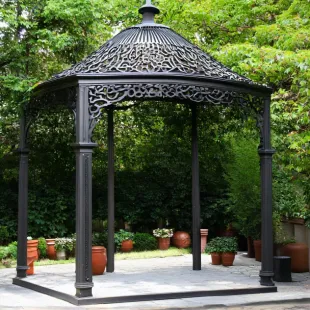
Jul. 30, 2026
Guide to Weatherproofing Outdoor Ironwork
Outdoor ironwork, including elegant wrought iron gazebos, enhances the charm of gardens and patios but can be susceptible to weather-related damage. Proper weatherproofing is essential for maintaining their beauty and structural integrity over time. In this guide, we’ll explore effective techniques to weatherproof your outdoor ironwork, ensuring that your gazebo withstands the elements while
Jul. 29, 2026
Beginner’s Guide to Welding and Forging Basics
Welding and forging are crucial processes in metalworking that cater to hobbyists and professionals alike. Whether you're crafting sturdy structures or unique decorative items using wrought iron supplies, understanding the fundamentals is essential. This guide addresses common challenges faced by beginners, such as safety concerns, tool selection, and technique mastery, providing clear solutions
Jul. 27, 2026
Guide to Comparing Iron Ornament Prices
If you are a craftsman, designer, or homeowner looking for Wrought Iron Supplies to enhance your aesthetics, this guide is meticulously crafted for you. Ever find yourself daunted by the vast range of prices for cast iron ornaments or unsure of their value? You’re not alone. Many individuals face confusion when navigating the price spectrum of iron ornaments due to varying quality, designs, and

Jun. 23, 2026
How Custom Cast Iron Floral Plates Enhance Luxury Gate Designs
In the world of luxury gate designs, homeowners often struggle with achieving a distinctive and elegant look that stands out in their neighborhood. Custom cast iron floral plates offer an aesthetic solution to these challenges, enhancing curb appeal while reflecting personal style. Many consumers, like Sarah from Scottsdale, Arizona, reported a significant positive transformation in their
Jun. 23, 2026
What Surface Finish Is Best for Cast Iron Garden Ornaments
The cast iron ornaments wholesale market has gained significant momentum in recent years, transforming outdoor aesthetics for homeowners and landscapers alike. This surge is primarily due to the robust durability and aesthetic appeal provided by cast iron materials, addressing the common pain points associated with traditional garden décor. With the rising demand for sustainable and long-lasting

Jun. 23, 2026
Powder Coated vs Electroplated Cast Iron Ornaments: Which Lasts Longer
Powder coating is a dry finishing process that uses finely ground particles of pigment and resin, which are electrostatically charged and sprayed onto a surface. The coated object is then cured under heat to form a hard finish. This process is widely used for creating durable and decorative finishes on metal objects.

Jun. 23, 2026
How to Reduce Procurement Costs When Buying Cast Iron Ornaments Wholesale
As a business owner or procurement manager, finding ways to reduce expenses while ensuring quality can feel daunting, especially when purchasing items like cast iron ornaments wholesale. Fortunately, I am here to share clear, actionable steps that will empower you to effectively cut procurement costs without compromising on the quality and artistry that these iconic adornments represent. By

Jun. 18, 2026
Top Industries Using Cast Iron Decorative Components in 2026
The decorative components market is pivoting towards durability and aesthetic appeal, with cast iron leading the charge. As we step into 2026, industries are increasingly faced with the challenge of sourcing high-quality decorative components that not only meet their design needs but also their durability demands. Pain points like fleeting trends and easily damaged materials prompt businesses to


Related Products
Our products are made from high-quality materials, ensuring durability and longevity, even in harsh outdoor environments.

Decorative Cast Iron Flower Panel KB-H09
Cast iron panels, made of cast gray iron, with ancient elegant looking,various model, widely used for iron fence and gate decoration.

Ornamental Cast Iron Panel KB-H08
Cast iron panels, made of cast gray iron, with ancient elegant looking,various model, widely used for iron fence and gate decoration.

Ornamental Cast Iron Panel KB-H04
We produce a wide variety of cast iron flowers. According to the preferences of customers from different countries, we have accumulated many styles for customers to choose from, our big cast iron range helps customer choosing more cast iron designs that they like.

High Quality Cast Iron Fence Finials SP-E028
The advantages and functions of the cast iron decorative spear tip mainly lie in the following aspects:

Decorative Cast Iron Spear Points SP-E018
The cast iron spearhead can significantly enhance the practicality and artistic value of ironware products, and is a typical example of the combination of functionality and aesthetics.

Factory Wholesale Durable Corrosion-resistant Wrought Steel Guardrail
The wrought iron and steel handcrafted balcony railings have significant advantages in terms of aesthetics, durability and personalized design due to their unique craftsmanship and materials.

Ornamental Wrought Iron Fence Railing for Balcony
The wrought iron balcony railings, due to their unique material and craftsmanship, have significant advantages and wide applications in architectural decoration.

Hot Sale Premium Wrought Iron Balcony Railing
Hand-forged iron balcony railings, with their unique craftsmanship and artistic appeal, hold a significant position in architectural decoration.

Sliding Gate V Groove Double Roller Wheel
The galvanized V-shaped steel double pulley is a worthwhile investment for professional color steel plate installation. It provides an important guarantee for high-quality, high-efficiency and safe construction.

Ornamental Cast Iron Fence Collar KB-R03-2
Cast iron collar is made of cast gray iron, cast iron has many advances:

Popular Wrought Iron Balcony Guardrail
Balcony wrought iron railings are a classic and enduring choice, known for their unique artistry and sturdiness.

Customized Cast Iron KB-R05 Fence Decorations
Cast iron collar is made of cast gray iron, cast iron has many advances:

Square Cast Iron Popular Bushes KB-R04-2
Cast iron collar is made of cast gray iron, cast iron has many advances:

Durable 3/4 Inch Cast Iron Square Studs KB-R04-1
Cast iron collar is made of cast gray iron, cast iron has many advances:

Need a Custom Solution?
We can draw drawings based on your ideas, create designs, and provide suggestions for improvements

